
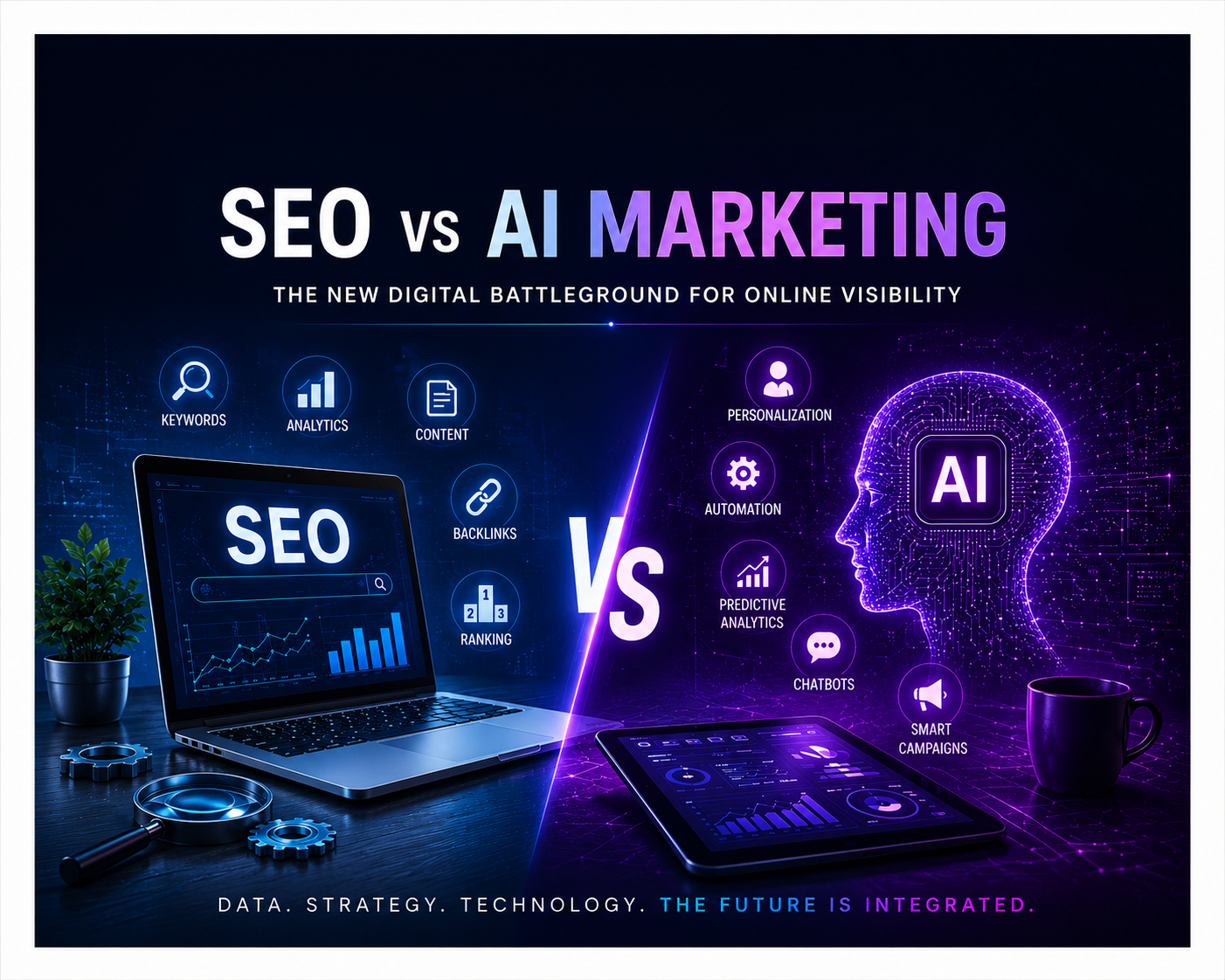
The digital marketing landscape is undergoing its biggest transformation since the rise of search engines. For nearly two decades, Search Engine Optimization (SEO) has been the cornerstone of online visibility. Businesses invested heavily in ranking on search engines, optimizing keywords, building backlinks, and creating content designed to attract organic traffic.
However, the emergence of Artificial Intelligence (AI) is changing how people discover information, products, and services. AI-powered search assistants, conversational engines, predictive analytics, and automated content generation are reshaping the customer journey. As a result, marketers are asking an important question: Is traditional SEO still relevant, or is AI marketing becoming the new king?
The answer is not as simple as choosing one over the other. Instead, the future belongs to businesses that understand how SEO and AI marketing can work together.
Understanding Traditional SEO
SEO is the process of optimizing websites to improve their visibility in search engine results. Its primary goal is to attract qualified organic traffic.
Key components of SEO include:
- Keyword research
- On-page optimization
- Technical SEO
- Link building
- Content marketing
- User experience optimization
For years, SEO has delivered long-term, sustainable traffic at a relatively low acquisition cost. A well-ranked page can generate leads and sales for months or even years without ongoing advertising expenses.
However, SEO has become increasingly competitive. Search algorithms are more sophisticated, ranking factors continue to evolve, and businesses must constantly adapt to maintain visibility.
The Rise of AI Marketing
AI marketing uses artificial intelligence technologies to analyze data, automate tasks, predict consumer behavior, and personalize customer experiences.
Modern AI marketing includes:
- AI-generated content
- Predictive customer analytics
- Automated email campaigns
- Chatbots and virtual assistants
- Personalized recommendations
- AI-powered advertising optimization
- Voice and conversational search experiences
Unlike traditional marketing methods that rely heavily on human analysis, AI can process vast amounts of data in real time, helping marketers make faster and more accurate decisions.
How AI Is Changing Search Behavior
One of the biggest disruptions comes from AI-powered search experiences.
Users are increasingly relying on AI assistants to provide direct answers instead of browsing multiple websites. Rather than searching for “best digital marketing agency,” users might ask an AI assistant:
“Which digital marketing agency is best for a small healthcare business with a limited budget?”
AI systems can generate personalized recommendations instantly, reducing the need for traditional search result browsing.
This shift means businesses must optimize not only for search engines but also for AI-driven discovery platforms.
SEO Strengths in 2026
Despite rapid AI adoption, SEO remains highly valuable.
1. Long-Term Traffic Generation
SEO continues to provide sustainable organic traffic without paying for every click.
2. Trust and Credibility
High-ranking websites are often perceived as more trustworthy by users.
3. Brand Visibility
Appearing consistently in search results strengthens brand recognition.
4. Content Authority
Well-optimized content helps establish expertise and industry leadership.
5. Cost Efficiency
Compared to paid advertising, successful SEO often delivers a better long-term return on investment.
AI Marketing Strengths in 2026
AI marketing offers several advantages that traditional methods struggle to match.
1. Hyper-Personalization
AI can tailor content, offers, and recommendations to individual users.
2. Speed and Automation
Tasks that once required hours can now be completed in minutes.
3. Better Data Analysis
AI identifies patterns and opportunities hidden within massive datasets.
4. Improved Customer Experience
AI-powered chatbots and recommendation engines enhance user engagement.
5. Smarter Decision Making
Predictive analytics helps businesses anticipate customer needs before they arise.
The Challenges of SEO
SEO faces several challenges today:
- Increasing competition
- Frequent algorithm updates
- Longer ranking timelines
- AI-generated search summaries reducing click-through rates
- Rising content quality expectations
Businesses that rely solely on SEO may experience slower growth compared to competitors leveraging AI technologies.
The Challenges of AI Marketing
AI marketing is powerful but not perfect.
Common challenges include:
- Risk of generic content
- Potential inaccuracies in AI-generated information
- Privacy and data concerns
- Dependence on technology platforms
- Reduced human creativity and emotional connection
Successful marketing still requires strategic thinking, storytelling, and brand authenticity.
SEO vs AI Marketing: Which One Wins?
The real winner is neither SEO nor AI marketing alone.
SEO provides discoverability.
AI provides intelligence and personalization.
SEO attracts users.
AI converts users.
SEO builds authority.
AI improves efficiency.
Businesses that combine both strategies achieve the strongest results.
The Future: AI-Powered SEO
The next generation of digital marketing is AI-powered SEO.
Forward-thinking marketers are already using AI for:
- Keyword discovery
- Content planning
- Competitor analysis
- Search intent mapping
- Technical SEO audits
- Performance forecasting
- Content optimization
Rather than replacing SEO, AI is making SEO smarter, faster, and more effective.
Final Thoughts
The debate between SEO and AI marketing misses the bigger picture. The future of digital success lies in integration, not competition.
SEO remains the foundation for online visibility, while AI marketing enhances personalization, efficiency, and customer engagement. Businesses that embrace both technologies will be better positioned to capture attention, build trust, and drive sustainable growth.
In 2026 and beyond, the most successful brands will not ask whether SEO or AI marketing is better. They will focus on creating a strategy where AI amplifies SEO and SEO fuels AI-driven customer experiences.
That is where the real competitive advantage lies.